Saturday, June 6, 2009

Blog Post 8 – Getting into the Rhythm of Things (June 4)

I think I'm starting to get a feel for Pemba, which is to say that I am getting better at embracing the unexpected, and going with the flow. For example last Saturday the power went off, and stayed off. Apparently the Kafue weed has suddenly blocked the dam, and reduced the water flow, and places like Pemba didn't warrant power except between 23:00 and 01:00 at night. Which is inconvenient if you require electricity to power your electric water pumps, though Mukalabi and I fortunately had a large stash of water. Now things are getting better, and I am hopeful we will continue to get power, for at least some useful times of the day.
Take Monday, when I went to work and no one else showed up. So I did some reading, got up to speed on the reports our office writes, and then went for a bike ride. It is always neat to walk or ride around Pemba, because everyone is friendly, and greets you as you travel. It can be slightly embarrassing when they know me by name, and I don't even recognize them, but as the only 'Makua' (white man) in town, I'm getting pretty used to it. The kids here are quite funny, as they like to stand in their yards and yell “HELLO! HOW ARE YOU MAKUA?”, or some similar variant, over and over again until I greet them properly.
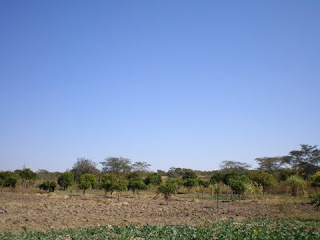
Or Tuesday, when I went to Mr. Morrison's to see if I could start moving in. Apparently he meant Tuesday, Zambian Standard Time, as I will not be moving until next Monday at the earliest. But I did ask his permission for a couple pictures of his farm, and I have posted one here of him and his watering apparatus. And one huge advantage of visiting farmers is all the produce we get, oranges, potatoes, and whatever else they have to give us as gifts for stopping by.
Or yesterday, when Willard and Lianne had some other things to do, so I went with Mukalabi to see what his work promoting Conservation Farming was like. I learned a ton about different planting techniques, fences made of closely spaced plants to keep animals out of gardens, and saw a farm that was harvesting maize, to the tune of 200 bags and counting (most farmers will get 60 if they are good). Pauline, a friend of Mukalabi, is married to a European, and appears to be quite well off. She drives a truck (owing a vehicle is pretty rare) and rents the farmland where they are harvesting an incredible amount of maize (interestingly enough, the owners of the land are not nearly as good farmers). She also runs an agro-dealer shop, selling seeds, fertilizer and stuff like that. And lives in a fantastic house, complete with a patio, fence, and all that. It was quite interesting living the good live for a couple hours, talking politics with a highly educated Zambian, and eating a fantastic meal. It was an interesting contrast to the usual livelihood of farmers I see here in Zambia.
Or today, when I attended my first farmers meeting, which was cool, except that I hardly understood anything. I am getting good at the Tonga greetings, but beyond that, I am quite inept at speaking or understanding Tonga. And for some reason, everyone assumes I am quite knowledgeable about all matters to do with farming, business, wealth acquisition and stuff like that, and just by my telling them stories of Canada, they expect to find solutions to poverty. If only it were true! Ah well, just one more thing to get used to. And while I ponder how to come across as less of an authority figure, and more of a student learning about Zambian farmers, I leave you with a picture of the farmers at the meeting examining the treadle pump and demo gardens...
...Mike

Blog Post 7 – First week of work (May 29)


The power goes out in Pemba a lot. At least every couple nights around dinner time for about an hour and a half, and then sometimes in the day as well. Its some sort of power sharing scheme, to ensure that Zambia can get by on as few power plants and dams as possible. Though I'm not sure what the ecological effects of everyone cooking on charcoal are. It is times like these, when there is no light (daylight is from 6AM to 6PM), and my house-mate is away somewhere, that I am very thankful for the comfort of my 6 hour battery life on my laptop.
Soon, I will be very used to the lack of power. Tuesday I started work for real -- Lianne and I rode to some local farmers on our bicycles, and I met a farmer that soon I will be staying with. Mr. Morrison is an excellent farmer, I'm guessing he has about 10 acres of land, full of cabbage, beans, tomatoes, peppers, and a few orange trees. He is near a stream, which he uses for irrigation – he pumps water into a couple massive drums using his treadle pumps (it takes about half an hour to fill). Then he opens the valve on the drum, and using a long hose he waters his crops. I'm sure after staying with him for a while I will be able to learn a ton about farming in rural Zambia. And he has said that I can grow a small garden on his land, which I am looking forward to greatly.
My future home is about a 30 minute bike ride from Pemba, so I am looking forward to some good exercise in the morning. And there is no power, so I suppose I will be charging my devices at work. And getting home at a reasonable hour will be a must, as Zambia gets increadably dark at night. I am excited about getting away from my current life though, I didn't come to Zambia to watch crappy pirated DVD's, or listen to Chris Brown, or play pool in the evenings, as I can do all that in Canada. But in Canada I don't have the opportunity to live with a farmer who has 2 wives, or eat nshima every meal and observe how a rural farmer's family interacts.
Anyway enough excited speculation, I'm sure I will have good stories about rural life after living with Mr. Morrison for a few weeks, and now I will discuss work.
Some background: Zambians in the Southern Province generally grow maize, and harvest about now. Maize is a rain-fed crop, but now the rains are done, so any crops will require the use of irrigation. And by done, I mean it will probably not rain the entire time I am here. Maize is sold to the government at a price of about Kw 65000 per bag, which is about $13 CAD or so. I think good farmers will harvest about 100 bags. But the government only pays you in October, so you can also sell to other people now for about Kw 48000 per bag and get cash now. I believe this is illegal. Traditionally this single sale is the only source of income for the farmers, so they either use the money to buy ground maize to make nshima, or grind it locally and store it to feed their family for the rest of the year. Now the farmers are looking to other ways of making money, which IDE is strongly encouraging. Some already have established gardens of cabbage, tomatoes, beans, rape and peppers. Most of these plants are small and are in the transplanting stage, but some cabbage and rape is ready for harvest.
So Tuesday we went about 5 km into the field on our bicycles (yes, it shouldn't take 30 minutes, but you are not considering the sandy dirt roads or the Zambian speed at which we travelled), past the school and to a few farmers gardens. I say gardens partly because that is the word to describe a non-maize plot, and because these plots are often literally the size of gardens. Good ones are about 30 paces by 50 paces, and not so good ones are maybe half or a quarter of that size. The biggest barriers to large gardens seem to be access to water, as it often requires the farmers to walk a few hundred meters from the water source to the plot, carrying the water in a bucket. Mr. Morrison is able to grow such a large number of plants because of his treadle pumps.Wednesday Lianne was tired from all the cycling, and we walked to a local cluster of houses sponsored by the Catholic Church. In all there were 13 families, and all are members of the IDE project. The houses are quite reasonable, compared to other local houses, and all are about 500m from either of 2 hand water pumps. Each has a decent size of land for a garden, and most are taking advantage of it, some more than others (one farmer was making bricks from mud obtained by mixing water with dirt from a local termite mound, to supplement his gardening income). Some farmers had potentially a few hundred kg of crops to be harvested in August or September, while others will only have a few kg. It was very interesting to see the differences in quality of crop, and I hope to find out why some are bigger and better than others. A couple hypotheses I'd like to examine: size and composition of family, soil quality, other part time or full time jobs.
Thursday Lianne was still too tired, but Willard and I went to meet the chairman of the closest group, who is also a good farmer. He owns a guest house, which he is renovating, and a significant portion of land which his garden is on. He told me that if he could obtain a source of credit, he would make his garden 2 or 3 times larger, and was showing me his weir dams, where his tank and treadle pumps will go when he buys it, and his drip irrigation system which is pretty good. He was confident that he could manage a larger farm, even while working on his guest house. However when I probed further, he also mentioned that besides credit, the other main problems facing Pemba farmers were access to water and access to markets. In fact, with the current markets available to him, he probably couldn't even sell what he had, so I'm not totally sure if obtaining credit would help him or hurt him. Especially with the interest on loans being insanely high (I think up to 25% if I understand correctly).
During these 3 days, we were talking to the farmers to collect information. We are trying to find out what farmers are growing which vegetables, and when they expect to harvest, so that we can try to find markets for them. This is important because it appears local supply far exceeds local demand.
Friday we had a team meeting, so while during the other days I was able to find out what the farmers identified as issues, Friday I found out what the IDE workers saw as major obstacles. IDE Pemba is divided into 3 field offices, which are about 100km apart. Without internet, it makes for very awkward communication lines, so the team meetings that happen a couple times a month are pretty important.
From what I could gather, the field workers are having major problems disseminating the information that they have. The plan is to teach program promoters (PPs) in each of the major zones, and then the PPs are supposed to spread the info to the other farmers. However Tonga farmers live very far apart from each other, even within a village, and it can be hard for the PPs to travel between the farmers to teach them. Add on the fact that IDE does not offer incentives to the PPs and other local NGO's do (for example bicycles that enable the PPs to travel to other farmers), and the field staff are getting quite frusterated.
Even in training sessions where farmers do show up, the IDE staff sometimes make little progress. For example, one of our pillars is Gender (the others are input supply, marketing, capacity building in farming techniques, irrigation and credit) and while many farmers promise they will be more sensitive to gender issues during the trainings, in practise there is no change. Because Tonga's are quite polygamous, and traditionally men and women have very different roles, this is a major sticking point.
On the positive side, there are some successes. We have obtained a possible source of credit for some farmers. Markets are being found in local schools, hospitals, Spar market and the like. And irrigation is being widely embraced, with over 100 farmers requesting vouchers that will reduce the cost of irrigation technology that they wish to buy. This includes treadle pumps and drip irrigation kits.
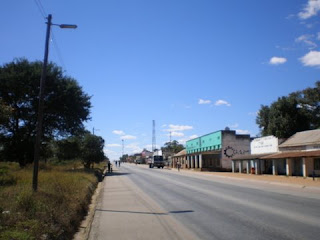
So that was the first week of work for me, and here are some pictures of Pemba to show you what I've been up to. My camera had an incident, I broke the LCD screen, but it still takes pictures, so I just have to guess what I'm aiming at and it seems to still be OK. Next time I go to Lusaka (in a month or so) I can hopefully get the screen repaired, and then go picture crazy...
...Mike


Thursday, May 28, 2009

Blog Post 6 – First thoughts on Pemba (May 24)


So I've only been here 3 days, so I am probably not completely qualified to comment, but I will anyway. There is a ton to explain, so I will list some Zambian facts here, that you will need to understand in order for the story to make sense. However I this post will still be pretty disorganized and jump around everywhere, and long.

-There is no garbage collection in Pemba (or most of Zambia from what I've seen). This means you throw your garbage wherever you like, in the road, in the ditch, sometimes in big holes in the ground.
-Everyone sweeps their yards. Yards are small (20 or 30 sq ft.) dusty patches of sand.
-Washing and evacuation tasks are undertaken in different venues depending on the location.
-Zambia is cold in the winter. I was surprised, but often at night and the morning, or when it is cloudy, I am wearing a sweater or jacket, and apparently it gets colder, before heating up in August. I am actually considering getting another sweater, but we will see.

For now I am staying with a 27 year old Zambian, Mukelabai, who is a friend of my counterpart. Mukelabai just moved into a new place the day I arrived, so the two of us are sharing a 5 room house. The first thing that had to get done, according to Mukelabai, was to fix up and clean the place. While I expected this meant we would spend some time cleaning the yard and rooms, it actually meant he had paid a local woman to clean the inside, and pick up all the garbage and sweep the yard. Today we also did some more sweeping and cleaning ourselves, and its starting to look pretty good, though there are spiders and cockroaches everywhere (including all over the food!)

I probably won't stay here too long, maybe a week or two. I am hoping to meet some of the local farmers over the next week, while working with IDE. Some nearby villages are only 5km or so from the office, so I can easily walk or ride a bike from one of them to work in the morning and night. It would be good exercise too. I am hoping that if I get on this right away, I can even start a small garden of my own, and get a feel for how to grow vegetables, and how local farmers deal with irrigation, weeds and fertilizers. Something like tomatoes or onions could probably be harvested before I leave in August.

Mukelabai and I have running water, at the tap outside. In Pemba, the water comes from 5 boreholes and is pumped out using electric pumps. Then it is chlorinated, and stored in the water tower. This is fed underground to a series of taps, it appears there is one in each yard. Generally you will fill a bucket (or many buckets) with the water and use this for your water needs. It is interesting to see how much less water you use for things like washing your hands, showering and dishes when you have to carry your own water, even from a nearby tap. Staying in a village could be pretty interesting.

Today we did the laundry, which was fun. The preferred laundry detergent here is BOOM which apparently makes your clothes lighter after some use, so I'm glad I don't have any super nice clothes here. The technique is as follows: you fill a bucket with water, and squeeze out some BOOM paste into your hand. You rub this into the water, to make suds. Then you put some clothes in, and grab a fistful of the clothing in your left, and rub with another part of the clothing your right. For stains, just apply extra BOOM. Then you rinse in a second bucket, and make sure to get all the BOOM out. Hang dry on a clothsline. It probably took me an hour and a half to wash 5 shirts, a pair of khakis, and socks and boxers... so there is room for improvement. But they are drying pretty fast.

Here is a picture of my first morning at the office. Yes, that is men standing around fixing a motorbike. After a while of learning the ins and outs of fixing stuff with very limited tools, which people here are excellent at, I went inside the office and talked with Liana about what she has been up to. Liana is an intern from one of the local collages, and has been at IDE since February. She has been going to 3 local villages, interviewing farmers about their crops to find the most profitable vegetables. Recently (in the last week of so) she has setup some demonstration plots at each village, to showcase correct planting techniques. She will be gone before the crops are done, so part of my job is to go around with her over the next month or so, learn how to do her work, and then take over when she leaves.

For bathroom uses near the office, there is a concrete room and a door, which I opted to close, and then found myself locked in! I had to climb out the window, much to the amusement of my counterpart who explained to me that the door automatically locks, and the door handle is missing, and then opened it using a spoon. Bathroom facilities are a hole in the concrete floor, which is the entrance into a pit about 20 ft deep (my best guess by shining a flashlight down). Aim is important, since the hole is only about 5 inches wide, by 10 inches long. Showering requires a bucket of water and soap, and then you sweep any excess water into the hole with a nearby broom. Some places do have flush toilets, but no running water, so you have to flush with a bucket of water.

Our house has some interesting electrical oddities too. Only 3 light bulbs can be on at once, without tripping the lighting circuit. However the electric stove, Mukelabai's stereo and TV equipment, and 2 laptops can be plugged in without any issues. “The stove has no power switch” explains Mukelabai as he separates the hot wire from the stove from the hot wire from the wall, and a small stream of blue sparks appear. The wires are bent into hook shapes to facilitate this primitive power switch. Hmm, pretty sketch.

I should mention that the stars here are unbelievable! It is insanely dark in Pemba, because there are almost no streetlights, and everything goes quiet past 6 or 7 at night. You can look up and see way more stars than I can see, even in Langley.

I know this was a fairly long post, as there are a lot of neat things about Pemba. Instead of trying to detail each one now, especially with my limited knowledge and experience, I think over the next month or so I will try to document a few things in more depth. A quick sneak preview of upcoming blog posts could include: food in Zambia, nearby towns, the market, clothing, village life, and of course a day in the life at IDE...

...Mike

Wednesday, May 20, 2009

Blog Post 5 Divide and conquer (May 20)


IDE Head Office - this is a scaffold that is used to test the treadle pumps at all different heights and flows and stuff.


First a quick shout out to all the blog commenters – you have far exceeded my expectations, so keep it up and make me look like I have tons more friends than any other JF this summer. I promise in the future there will be sweet pics and insightful stories to comment about, but for now the comments are really awesome!

Tonight should be my last night with other mazungus for a little while. Probably means no more beer for a month or so too. I had a good chat with my coach, and finished training at IDE. Then we all went for Indian Food, said goodbyes to all the OVS. Tonight was also my first encounter with diarrhea in Africa, so, yeah, that. I heard all the West Africa JFs had it within a day of hitting the tarmac, so I guess I'm doing OK.

Training at IDE was pretty awesome. The first day we discussed what market facilitation is. Essentially its the idea that with a very 'light touch' a market facilitator can connect buyers and sellers, and then step back and let stuff happen. About lunch time I discovered I stayed in the sun way too long the day before, and had heatstroke. This meant I spent my first afternoon at work trying my best not to vomit during the session, or fall asleep in front of the country director. At least I didn't vomit.

Today we had some cool discussions about how market facilitation is actually achieved. This means we discussed possible markets for farmers, and how effective each one could be. We had a neat framework for assessing buyers in terms of risk, needs, demand, and other factors that could affect the relationship. All in all I learned a ton, and I'm super stoked to put it in practise.

Tomorrow its off to Pemba, the land of debatable internet access. It will be interesting to see how close my expectations compare to reality. I have a mental picture of some dusty huts at the side of a dirt highway, surrounding a well and maybe a school. In reality, I think the only part I have right is the highway's existence, and I'm pretty sure its paved. Hmm, could be a good opportunity for some pictures – I apologize I haven't felt very confident yet in the photo department, so I will definitely have to step that one up a notch.

Anyway, my only real reason for writing this is in case I don't have internet for a while, so I shall stop rambling and get some sleep...

...Mike

(p.s. The next morning diarreah still there, and its really not a lot of fun. Should make for an interesting travelling day)

Monday, May 18, 2009

Post 4 – Lilongwe (May 15)

We landed last night and are staying at the Golden Peacock which is a pretty fine establishment. Everyone gets their own bed, mosquito net and there's 6 showers (definitely a cut above the EWB house). No internet access, but we are in Lilongwe so the fact that you are reading this means that I succeeded in finding myself an internet cafe (so I'm writing this yesterday night if I haven't confused you enough yet).

Scavenger hunt! We partnered up and headed into the town to find a bunch of stuff. Mike and I (yeah, I know) spent about an hour just finding our way into the town, and then getting our hands on some cash. After talking with a few people, we determined our options were the bank ATM, or the black market trader near the bridge... and given the local wouldn't go anywhere near the black market guy then we decided it wasn't a good choice. (Turns out there was a Bureau de Change) that had pretty decent rates, but we didn't find out about this until we talked with other JFs. Now we had local money so our bargaining leverage was greatly increased.

Other things on our list were cell phones, potions from the witch doctor, malaria cure, and a ton of wierd stuff from the market that was not in english. Luckily we found a couple really nice local men who were just hanging around and were super stoked to show us where to buy stuff in the market. We got a couple chitenges (multipurpose cloth things), white beans, cassava, avacoado, bread, some Fanta, banannas sandles and a sweet serving spoon.

Oh and also on the list was this beer called chibuku, which comes in a 1L carton, and is made from maize and sorghum, and not only tastes gross, but also has tons of floating grains of stuff. Really rough when you get to the bottom of the carton, because the top of the carton where you put your mouth is soggy, and all the floaties are more concentrated as you get to the bottom. To top it off, the slogan is “Shake, Shake” and everyone who saw us white guys (azunga) carrying it got a pretty good laugh (though we got more people talking to us and shaking our hands than before we were carrying the beer). And the guy who sold it to us very sincerely stated how he appreciated that we were drinking the beer and trying his culture.

Still don't have my cell phone yet, but I've heard of a couple good places to buy it, and I'm in no rush because I'll need a Zambian SIM card anyway. Sounds like the thing to do is buy a phone with a flashlight, especially for when you're in a smaller village. And we didn't manage to get to the witch doctor, though another group found him and bought some magical headache cure. I also want to go back and buy some toilet paper (if I run out of other topics, I may discuss the different toilet techniques in a later post) and water purification tablets (think I managed to leave mine at the EWB house). And of course to put this post online.

To cap off the day, I had nshima tonight for the first time! We went to a couple of the local OVS host families for dinner. We had nshima (maize flour rolled into balls) with a ton of relishes (chicken, beans, rape, pumpkin seed and mustard leaves) as well as rice, oranges and banannas. The technique for nshima is pretty cool: you take a chunk of the nshima in your right hand and roll into a ball. Then you make a depression in the ball, so it looks a bit like a scoop. Using your scoop and thumb, you scoop relish into the depression and then put it in your mouth. I thought it was pretty good, but let's reevaluate how I like it after 3 and a half more months of nshima for breakfast, lunch and dinner.

Looks like tomorrow we have some more serious sessions going on, and a sector meeting (which means I'll be chatting strategies with Thulasy and all the IDE team. Hopefully party it up a bit that night, and then next morning board the bus for Lusaka. Monday, Tuesday and Wednesday I think we are at the IDE head office, and chilling in Lusaka, and then its off to the real work. I'll try to have a post or two online before I leave Lusaka, then I'll be 80km from Monze which looks like the nearest town that has internet and an ATM. Good news is that buses pass by fairly frequently, since I am on the main road in the Southern Province, but I won't expect that blog posts will be all that frequent. Instead look forward to checking my Twitter for news, as I can start updating that once I get myself a cell phone...

...Mike

Post 3 - May 14

Meant to write this a couple nights ago, but then we started drinking beer, and I had to postpone my writing. The last couple days have been pretty insane, we had a pretty sweet set of sector presentations; I made up a sweet game about market facilitation which totally flopped. And on the last day we spent the afternoon on a mini-project where we interviewed 'farmers' and formed a proposal about how a certain project worked. It was a good introduction to field work, and I learned a lot about how I ask questions.
Right now I'm sitting in Amsterdam airport, which is actually a pretty nice airport. Its pretty surreal, being this close. Of course I still have a week or so of travelling before I reach Pemba – when we get to Lilongwe we spend a couple days for in-country training. Then we head for the Zambia border, so we aren't in Malawi for the elections. After a long bus ride, and a couple days visiting the head office for IDE, I finally head off to Pemba to meet my counterpart and figure out exactly what I'll be doing.
Its looking like there are five JFs working for IDE this summer – Vicky, myself, Deg, Sierra and Tony. We are all working on projects related to output markets. The current hypothesis is that the main bottleneck in IDE Zambia's RPI (Rural Prosperity Initiative) is the market facilitation capacity of the field staff. Our job is to partner with existing field staff in the IDE field offices, and find ways to develop output markets in partnership with them. In the process of doing so, we hope to increase the field staff capacity, since they will still be working on the project long after we have left.
One neat part of this project is that we are using an interesting framework: the Value Chains Framework. Instead of the Livelihoods Approach which looks at people and the work they do and the way they live, the Value Chains Framework is more focused on how a product works its way through a market, and what stages add value to the product. For example, a t-shirt starts with a farmer buying cotton seeds and fertilizers and maybe a pump. Then the cotton is harvested and transported to the manufacturer. Finally the manufacturer makes the t-shirt and sells it to the store, who sells it to a customer. The value chains framework looks at all of these stages and searches for weaknesses.
Next a person called a market facilitator is used to repair or form poor or missing linkages. For example a smallholder farmer (farmer with a small plot, in the region a couple ha.) may not be able to sell on at market because he is too far away and has no means to transport his goods. If a market facilitator noticed that lots of nearby farmers had this problem, they may recommend to a manufacturer or supplier to send a truck down to these farmers every week or so to buy the goods. Ideally a contract would be formed to alleviate any issues arising from the farmers not knowing the correct market prices. After some time, the market facilitator can step away from the project, and with a little M&E (monitoring and evaluation) the linkage should continue by itself.
Anyway, time for me to catch a flight, enjoy a couple free Heinekens and get some sleep. I'll hopefully post this one in Lilongwe, once I locate an internet cafe...
...Mike

Friday, May 8, 2009

Post 2


We did a neat activity in predep today. We looked at all the people we want to communicate with this summer, and what they are likely thinking right now. Then we figured out how to change this to what we want them to be thinking. Ergo, blog post number 2...

...A week or so ago, I saw the whole pre-dep (as in predeparture training) thing as a massive black box. The scary pre-dep mystique. Time to change this, so I will paint a little picture for the interested reader, and the uninterested reader can skip to paragraph (*).

U of T is an awesome campus. Sitting at a window in the engineering building I am looking out over Collage St. Cyclists and cars and pedestrians pass by 2 floors below me, and I'm surrounded by old brick buildings. Straight ahead is the CN tower. I love looking at other people's campuses, I guess its my version of stalking, and a campus in the downtown area is really sweet. Still haven't found the library, but all the doors are locked, so I won't have a chance to explore today.

The last couple days have been pretty insane. I'm at about 10 hours of sleep for the last 3 nights, and I would say that each day is as mentally demanding as exam season. Its a bit like national conference, but with fewer people per workshop, and homework, not drinking to end off the day. Definately no chance for midday naps, and sleeping in would be grounds for 'unfortunate accidents'. Each day is full from 9 AM to 7 PM (at least) of workshops, tours, role plays, case studys, and discussion.

And the EWB house! Picture 25 people crammed into a 3 floor house. And each floor 2/3 the size of the engineering lounge at SFU! Rules and lists for shower times, house rules, cooking and cleaning days, and of course every bit of floor space and couch space taken up. I think I'm just a little bit too introverted to want to spend all my free time there, which is probably why I'm hiding in the engineering building at U of T listening to my ipod. Besides, last couple evenings involved lots of sitting around on the couches with everyone on thier laptops, so I don't feel too bad about hiding for an hour infront of my laptop. Oh, and not a huge fan of rules, though I am looking forward to cooking with my cooking team on monday. Suggestions? I need it to be vegitarian, and for 25 people.

(Paragraph (*))

Toronto vs. Vancouver? Tough question. I had a really decent sushi lunch with Danny Howard yesterday; food here is pretty decent. Transit is amazing! Picture a subway like the skytrain, except the train is actually as long as the platform i.e. 10 or 15 cars long. Streetcars are genius... they are electric powered, but only have one wire. I guess that means they ground themselves through the track – hence genius. But Vancouver has the ocean, and skimboarding, and mountains. And get this, the milk here comes in plastic bags! You have to buy special milk pouring jugs, then you pour the milk from those... its like a 3 step process. Milk jugs just seem so much easier to me.

So what's coming up? Why did I write a blog post now? I suspect that I will be 80 – 100 km away from internet of any sort this summer, and while I thought a pre-dep post was kinda lame, it is definately my best chance to use my blog. Soon as I get a cell phone in Zambia, I'm thinking of linking it to a Twitter account (search Mike Henrey). That way I can use my cell phone to update everyone. And then you all can twitter to my phone (I think) from your computers... which if it works may be cheaper than you texting me. Advise me on twittering if you are familiar, because I definately am not.

Another problem I have with lack of internet is solving my insatiable need for information. So here's my plan: Say I need some specialized piece of data for my work, i.e. average maize prices for the last 5 years in Lusaka. Then I update my twitter, or send out some texts. Then you can all get to your fancy internet capable devices, find the answers I need, and text me back. So yeah, don't be suprised if you get some strange messages over the summer. Also, if you can think of a good way of sending graphs, or information that wouldn't fit in a text (I was thinking picture messaging, but haven't hashed out the deets yet, or figured a way to do it cheap, and have no idea of the capabilities of my Zambia phone until I see it), let me know.

Otherwise, just thought I'd let you all know that training is pretty sweet, albeit pretty mentally taxing. I'm aiming to post again before I leave, to fill you in on my most updated placement details, possibly some fun stories from pre-dep, and of course to make you all super jealous that I'm off to Zambia. Until then I'll keep busy with kicking some pre-dep ass...

...Mike